About 10 minutes by car from Naru Port, an old school building stands near the clear blue water of Miyanohama Beach.
This is the Kasamatsu Hirotomo Memorial Hall, an art museum dedicated to Hirotomo Kasamatsu, a Western-style painter born on Naru Island.
The building was once Funamawari Elementary School. For approximately 132 years, generations of island children studied here before the school closed in 2007.
Rather than demolishing the familiar local landmark, the community gave it a new purpose. The classrooms and corridors were adapted into exhibition and creative spaces, and the memorial hall opened in 2008.
Inside, visitors encounter paintings inspired by the sea of the Goto Islands, family, Christian faith, the memory of war, and the hope for peace.
Outside, the landscape that shaped the artist remains close at hand.
Miyanohama Beach lies nearby, its water shifting from turquoise to deep blue. A protected grove of warm-climate trees rises beside the former school, while the forested grounds of Miyanomori Comprehensive Park extend behind it.
The result is more than a museum devoted to one painter.
It is a place where art, island memory, and the natural scenery of Naru meet.
A 132-Year-Old School Given a Second Life
The building that houses the memorial hall was originally Funamawari Elementary School.
Established in the early Meiji period, the school served the local community for approximately 132 years. It closed in March 2007 as the island’s school population declined and was consolidated with Naru Elementary School.
The building was not stripped of its history when it became a museum.
Its entrance and much of the first floor retain the atmosphere of the former school. Walking through the building, visitors can still sense the proportions of the classrooms and corridors that once formed part of everyday life for children in Funamawari.
The main exhibition spaces occupy former school rooms, creating an experience very different from entering a purpose-built urban gallery.
Here, large paintings appear in spaces that still carry the memory of lessons, school events, friendships, and the sounds of children moving between classes.
The memorial hall opened on July 5, 2008.
A place that once introduced young people to the wider world through education now introduces visitors to Naru Island through art.
A Boy Who Began Painting on Naru Island
Hirotomo Kasamatsu was born on Naru Island on January 12, 1938.
As a boy, he sometimes saw artists visiting the island to paint its scenery. Their presence fascinated him, and he began drawing and painting independently during his teenage years.
In 1954, he attended the Nagasaki Church of the United Church of Christ in Japan and became a Christian.
Faith would later become one of the central currents running through his work—not always through explicitly religious imagery, but through repeated themes of prayer, compassion, human suffering, and hope.
After graduating from Kaisei High School in Nagasaki City in 1957, Kasamatsu moved alone to Tokyo to pursue a life as a painter.
He enrolled at the Asagaya Art Academy and, in the same year, submitted a work depicting a souvenir shop in Nagasaki to the 25th Dokuritsu Exhibition.
He was only 19 years old when the painting was accepted.
From that point onward, he continued to present work primarily through the Dokuritsu Art Association, gradually establishing his place in Japan’s postwar art world.
Although he lived and worked far from Naru Island, the sea and memories of the Goto Islands never disappeared from his paintings.
Distance seems to have made his relationship with home even stronger.
One Artist, Many Different Worlds
The memorial hall preserves 82 large-scale paintings as well as smaller works, displaying them in rotation.
Visitors should not expect to see the entire collection in a single visit. The works on display change, which means the experience can differ from one season or exhibition period to another.
Kasamatsu’s style also changed dramatically during his lifetime.
His artistic development is generally divided into several periods:
Early Works, 1957–1969
Children’s Room, 1970–1973
Night Sea of Goto, 1974–1980
Daytime Landscapes, 1981–1988
Showa History, 1989–1998
Hidden Christian Cave, 1999
Angel Series, 2000–2005
The differences between these periods can be striking.
Early in his career, Kasamatsu created abstract paintings using a palette knife to apply paint with force and physical energy.
Later works introduced rooms, human figures, mannequins, ships, distant coastlines, European towns, angels, and the sea of his birthplace.
Colors shift from dark blue and black to vivid yellow, red, green, and white. Some paintings feel enclosed and deeply private, while others open toward light, distance, and the sky.
Walking through the exhibition is therefore not simply a matter of viewing several works by the same artist.
It is a journey through the changing inner world of one person.
The Mysterious Night Sea of Goto
In 1974, Kasamatsu began the series now known as Night Sea of Goto.
These paintings marked a significant change in his work.
Dark island waters appear behind silent interiors, wooden piers, departing boats, and headless mannequins. The figures are motionless, but the scenes feel filled with waiting, memory, and emotional tension.
Kasamatsu’s official museum describes the night sea of his childhood—particularly memories of squid fishing with his father—as one source of this imagery.
The paintings do not explain their stories directly.
Who is waiting beside the sea?
Has someone just left, or are they expected to return?
Does the water represent home, separation, fear, or the path toward another place?
The viewer is left to complete the scene through personal memories.
That openness is one of the strengths of Kasamatsu’s work.
For people who grew up on an island, the sea is rarely only a beautiful landscape. It is also a working place, a transportation route, a source of food, and a physical distance separating family and friends.
The darkness in these paintings carries that complexity.
From the Night Sea to the Light of Day
From 1981, Kasamatsu’s work changed again.
The deep, restrained atmosphere of the night-sea period gave way to brighter scenes commonly described as his Daytime Landscapes.
Colors became more vivid. Light entered the compositions. Figures and objects appeared within spaces suggesting travel, spring, departure, celebration, and renewal.
The emotional tone is not simply cheerful, but the paintings feel more open.
In 1983, Kasamatsu received the Independent Prize—the highest award of the Dokuritsu Exhibition—for works presented at its 51st exhibition.
The following year, he was recommended for membership in the Dokuritsu Art Association.
The recognition marked an important point in his career, yet his art continued to change.
He did not settle permanently into the successful style that had brought him the award. Instead, he moved toward subjects that were increasingly historical, spiritual, and concerned with peace.
The Sea of Goto, War, and Peace
From 1989 to 1998, Kasamatsu worked on the Showa History series.
The title refers to the Showa era, a period encompassing war, defeat, reconstruction, and enormous social change in Japan.
Kasamatsu spent formative years in Nagasaki soon after the Second World War. Goto City materials describe the scars left by the atomic bombing as a powerful influence on him.
Decades later, he turned toward the history of war in his paintings.
The Showa History works place images of destruction and human suffering alongside the rich, beautiful sea of the Goto Islands.
The contrast is central to their meaning.
The sea is not merely a scenic background. It becomes an image of nature continuing beyond human violence—a landscape that deserves to be protected from destruction.
Kasamatsu did not treat peace as an abstract slogan.
In his paintings, it is connected to familiar places, family life, the coast of his childhood, and the simple possibility of people living without fear.
Visitors who have already seen Naru Island’s blue water may recognize that the sea in his work carries both beauty and moral weight.
Hidden Christians and the Meaning of Prayer
In 1999, Kasamatsu created work centered on a cave associated with Hidden Christians.
The subject connected his personal Christian faith with the history of the Goto Islands, where communities preserved Christian beliefs throughout the long prohibition of the religion in Japan.
The following year, he began the final major phase of his career: the Angel Series.
In these paintings, towns and landscapes are often viewed from above. Angels appear over European streets and human communities, watching the world from the sky.
The viewpoint is broad, but the feeling remains personal.
After years spent painting the sea, war, isolation, and historical memory, Kasamatsu’s angels seem to carry a wish that people below might be protected.
He continued working until shortly before his death on July 17, 2005.
An unfinished large-scale painting titled Spring, the sixth work in the Angel Series, was later shown at the 73rd Dokuritsu Exhibition.
Because it remained incomplete, the work preserves something especially moving: the moment at which the artist’s hand stopped, while the creative intention was still moving forward.
Why He Is Called the “Painter of Love and Prayer”
Hirotomo Kasamatsu is often described as the “Painter of Love and Prayer.”
The phrase refers to more than his use of Christian subjects.
Throughout the changing periods of his career, several concerns continued to return.
One was his relationship with two places he considered home: Nagasaki and the Goto Islands.
Another was prayer—not only formal religious prayer, but the desire to protect life, remember suffering, and imagine peace.
A third was love for family.
These themes may appear through a dark sea, an empty room, a ship, a mannequin, a historical scene, or an angel above a distant town.
Kasamatsu’s visual language changed, but the emotional foundation remained remarkably consistent.
Visitors do not need specialist knowledge of modern Japanese painting to appreciate the work.
Begin with the picture that first attracts your attention.
Look at the direction of the figures’ eyes—or at the absence of a face. Notice where the sea begins, how the light enters, and what has been left unexplained.
The paintings often become more powerful when the viewer allows uncertainty to remain.
More Than a Memorial to One Artist
The Kasamatsu Hirotomo Memorial Hall was created not only to preserve the work of one painter, but also to support artistic activity on Naru Island.
It has served as a central facility in the “Goto Montparnasse” initiative, which seeks to use art as a source of cultural exchange and regional vitality.
Former classrooms have been used as artists’ studios and spaces for community art lessons.
The building has also hosted exhibitions by other artists, displays of work by local residents, creative workshops, and classical music performances.
An anagama climbing kiln stands in the former school grounds and has been used for ceramic production and firing.
This continuing activity gives the building a purpose beyond preserving the past.
A school is naturally a place where people learn and create. By turning its classrooms into studios and galleries, the memorial hall has allowed that role to continue in a new form.
The voices of pupils may no longer fill the corridors every day, but the building remains a place where ideas are shared and new work can begin.
Step Outside and Continue the Exhibition in the Landscape
The experience of the memorial hall does not have to end when you leave the galleries.
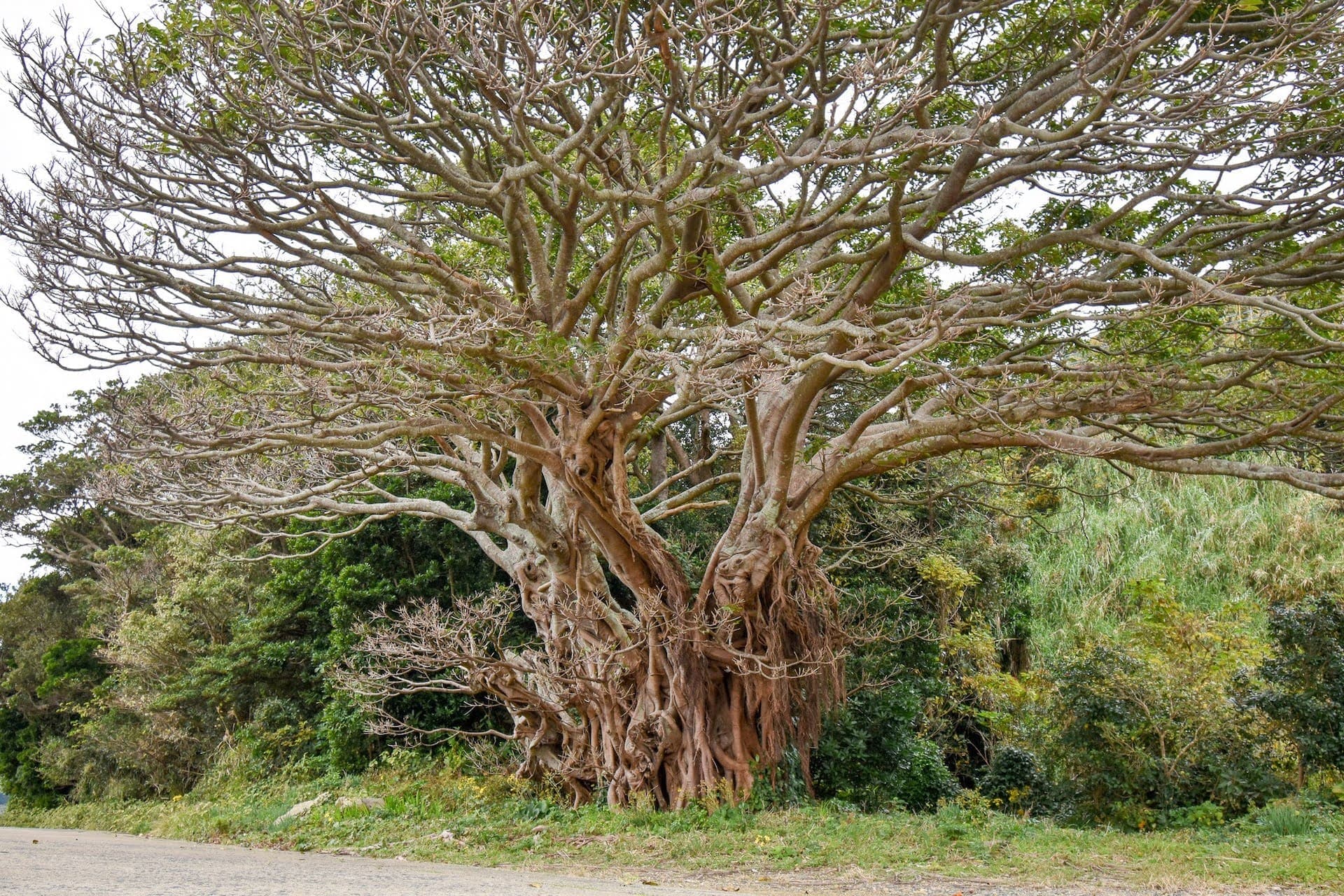
Beside the building is the Funamawari Shrine Grove, designated a Natural Monument by Nagasaki Prefecture.
The grove contains warm-climate species including holt’s machilus, nataore trees, isu trees, Japanese bay trees, and large akou figs. Several nataore trees have trunk circumferences exceeding three meters.
The dense greenery offers a glimpse of the natural environment characteristic of the central Goto Islands.
Miyanohama Beach is also nearby.
Its clear water and rounded pebble shore make it an ideal place to visit before or after the museum.
Inside the galleries, the sea appears through Kasamatsu’s memory and imagination.
Outside, the real water reflects the sky beneath the green mountains of Naru Island.
Looking at the paintings first and the sea afterward creates one experience.
Seeing the beach before entering the museum creates another.
Either way, the landscape and artwork begin to speak to each other.
Miyanomori Comprehensive Park and its campground are located behind the museum area, making it possible to combine art, a coastal walk, and time in the island’s forests.
A Quiet Place for a Rainy Day
Many of Naru Island’s attractions are outdoors: coastlines, rock platforms, beaches, and observation decks.
The Kasamatsu Hirotomo Memorial Hall is therefore particularly valuable when rain or strong wind changes an island itinerary.
Rain also suits the atmosphere of the former school.
The sound of water outside, the quiet corridors, and the large paintings can create a contemplative experience quite different from a bright summer visit.
A quick visit is possible, but allowing around 45 minutes to one hour provides time to follow the development of Kasamatsu’s work, notice the details of the old school building, and explore the immediate surroundings.
The museum is suitable not only for dedicated art lovers.
It may also appeal to visitors interested in abandoned-school architecture, island communities, Christianity in the Goto Islands, postwar history, or simply a calm indoor pause during a busy day of sightseeing.
Before You Visit
The Kasamatsu Hirotomo Memorial Hall is open from 9:00 a.m. to 5:00 p.m.
Last admission is at 4:30 p.m.
It is closed every Monday and Wednesday, as well as during the New Year period from December 29 through January 3.
The admission fee is 100 yen for adults and 50 yen for students. Residents of Goto City may enter free of charge.
Parking is available.
The reception desk and principal exhibition spaces are located on the second floor. Visitors who find stairs difficult should contact the museum in advance to confirm the current access arrangements and available assistance.
Because the collection is displayed in rotation, works featured on the official website or in tourism materials may not be on view during your visit.
Temporary exhibitions, gallery changes, events, facility maintenance, or severe weather may also affect normal operations.
Ask staff before taking photographs or recording video. Rules may vary according to the work, exhibition, and intended use.
Ferries to Naru Island may be delayed or canceled because of weather and sea conditions.
Rental cars and taxis are limited on the island, so it is best to arrange your ferry and local transportation together.